
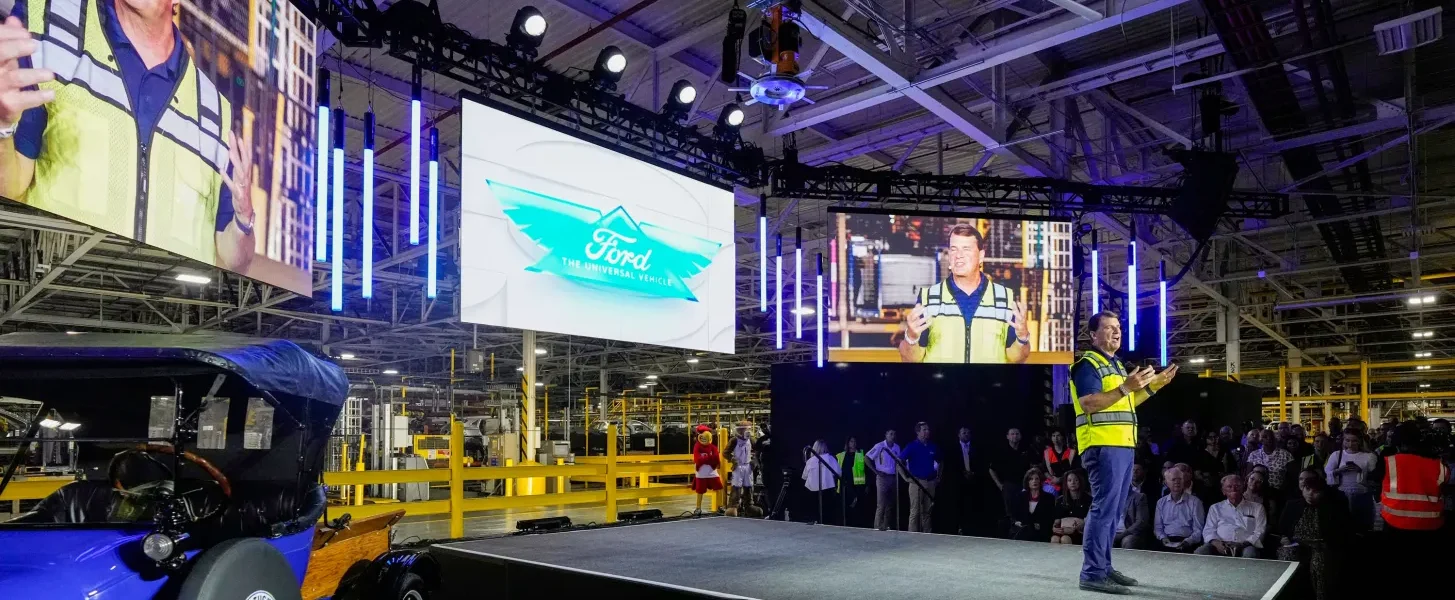

On Monday, Ford announced plans for an affordable electric truck with a 2027 delivery date and an expected price tag of about $30,000, thanks in part to a new manufacturing process that it says will help cut costs.
This could be the shot in the arm that the slowing US EV market needs. Sales are slowing, and Ford in particular has struggled recently—the automaker has lost $12 billion over the last two and a half years on its EV division. And the adoption barriers continue to mount, with the Trump administration cutting tax credits as well as rules designed to push automakers toward zero-emissions vehicles. And that’s not to mention tariffs.
But if anything can get Americans excited, it’s a truck, especially an affordable one. (There was a ton of buzz over the announcement of a bare-bones truck from Bezos-backed Slate Auto earlier this year, for example.) The big question is whether the company can deliver in this environment.
One key thing to note here: This is not the first time that there’s been a big splashy truck announcement from Ford that was supposed to change everything. The F-150 Lightning was hailed as a turning point for vehicle electrification, a signal that decarbonization had entered a new era. We cited the truck when we put “The Inevitable EV” on our 10 Breakthrough Technologies list in 2023.
Things haven’t quite turned out that way. One problem is that the Lightning was supposed to be relatively affordable, with a price tag of about $40,000 when it was first announced in 2021. The starting price inflated to $52,000 when it actually went on sale in 2022.
The truck was initially popular and became quite hard to find at dealerships. But prices climbed and interest leveled off. The base model hit nearly $60,000 by 2023. For the past few years, Ford has cut Lightning production several times and laid off employees who assembled the trucks.
Now, though, Ford is once again promising an affordable truck, and it’s supposed to be even cheaper this time. To help cut costs, the company says it’s simplifying, creating one universal platform for a new set of EVs. Using a common structure and set of components will help produce not only a midsize truck but also other trucks, vans, and SUVs. There are also planned changes to the manufacturing process (rather than one assembly line, multiple lines will join together to form what they’re calling an assembly tree).
Another supporting factor for cost savings is the battery. The company plans to use lithium-iron phosphate (or LFP) cells—a type of lithium-ion battery that doesn’t contain nickel or cobalt. Leaving out those relatively pricey metals means lower costs.
Side note here: That battery could be surprisingly small. In a media briefing, a Ford official reportedly said that the truck’s battery would be 15% smaller than the one in the Atto crossover from the Chinese automaker BYD. Since that model has a roughly 60-kilowatt-hour pack, that could put this new battery at 51 kilowatt-hours. That’s only half the capacity of the Ford Lightning’s battery and similar to the smallest pack offered in a Tesla Model 3 today. (This could mean the truck has a relatively limited range, though the company hasn’t shared any details on that front yet.)
A string of big promises isn’t too unusual for a big company announcement. What was unusual was the tone from officials during the event on Monday.
As Andrew Hawkins pointed out in The Verge this week, “Ford seems to realize its timing is unfortunate.” During the announcement, executives emphasized that this was a bet, one that might not work out.
CEO Jim Farley put it bluntly: “The automotive industry has a graveyard littered with affordable vehicles that were launched in our country with all good intentions, and they fizzled out with idle plants, laid-off workers, and red ink.” Woof.