
Circular Economy & Battery Value Chain: Closing the Loop in Electric Mobility

As electric vehicle adoption accelerates globally, attention is shifting beyond vehicle sales toward what happens across the entire battery lifecycle. The transition to electrified mobility depends not only on scaling production, but on building a sustainable, resilient, and circular battery value chain.
From raw material sourcing to recycling and second-life applications, the circular economy model is becoming central to the future of EV batteries. It reduces environmental impact, strengthens supply security, and unlocks new economic value streams.
Market potential and growth outlook
The global battery recycling and circular value chain market is expanding rapidly alongside EV adoption. As millions of electric vehicles enter the market each year, end-of-life battery volumes are expected to rise significantly toward the end of this decade.
Industry projections suggest strong double-digit annual growth in battery recycling and second-life energy storage markets through 2035. Increasing regulatory mandates for recycled content and extended producer responsibility are accelerating investments in closed-loop supply chains.
The circular battery economy is no longer optional — it is becoming a strategic necessity for manufacturers seeking long-term cost stability and compliance with sustainability regulations.
Understanding the battery value chain
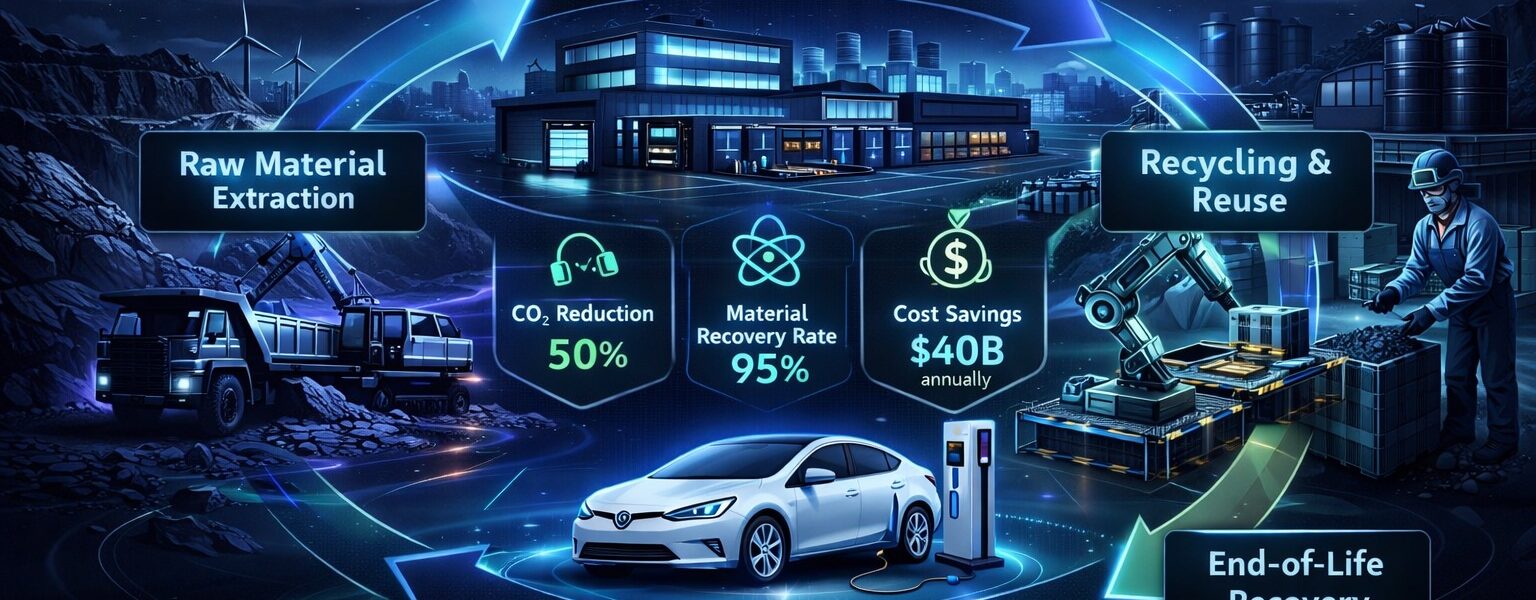
The battery value chain spans multiple stages:
- Raw material extraction — lithium, nickel, cobalt, manganese, graphite
- Material processing and refining
- Cell manufacturing and battery pack assembly
- Vehicle integration and operational lifecycle
- Second-life repurposing for stationary storage
- Recycling and material recovery
A circular model aims to recover valuable materials at end-of-life and reintegrate them into new battery production, reducing dependence on primary mining.
Key market segments
The circular battery ecosystem includes:
- Battery recycling facilities specializing in hydrometallurgical and pyrometallurgical recovery
- Second-life battery energy storage systems (ESS) for grid and commercial applications
- Material recovery and refining companies
- EV manufacturers integrating recycled content into production
- Digital battery tracking and lifecycle management platforms
Second-life batteries are emerging as a strong growth segment, particularly for renewable energy storage and backup power systems.
Key players and ecosystem participants
The battery circular economy involves collaboration between automakers, battery manufacturers, recycling specialists, and material processors. Industry participants are investing in:
- Closed-loop recycling systems
- Advanced material recovery technologies
- Automated battery disassembly
- Digital battery passports for traceability
- Sustainable sourcing certification programs
Strategic partnerships between OEMs and recycling firms are strengthening supply security while reducing environmental footprint.
Recent developments in battery circularity
Governments are introducing stricter regulations requiring minimum recycled content in new batteries and improved transparency in raw material sourcing. The European Union, for example, is implementing battery regulations that emphasize lifecycle sustainability and traceability.
Automakers are increasingly launching dedicated recycling programs and investing directly in recycling infrastructure to secure critical minerals such as lithium and nickel.
Meanwhile, advances in recycling technology are improving material recovery rates and reducing energy consumption in processing.
Technologies enabling circular battery systems
Several technologies are accelerating the transition toward a circular battery value chain:
- Hydrometallurgical recycling processes enabling high recovery rates of lithium and cobalt
- Direct recycling methods preserving cathode material structure
- Automated battery dismantling systems improving efficiency and safety
- Battery health diagnostics and AI-based lifecycle prediction
- Blockchain and digital tracking platforms ensuring supply chain transparency
These innovations are making recycled materials increasingly cost-competitive with newly mined resources.
Key drivers and opportunities
The circular battery economy is supported by multiple structural drivers:
- Rapid growth in EV battery production
- Supply chain risks for critical minerals
- Environmental and ESG compliance pressures
- Rising raw material costs and price volatility
- Government regulations mandating recycling and transparency
For manufacturers, integrating recycled materials can reduce exposure to commodity price fluctuations while improving sustainability credentials.
Future of the battery value chain
Over the next decade, circularity is expected to become embedded across the battery lifecycle. Recycling facilities will scale alongside gigafactories, creating localized supply loops that reduce transport emissions and geopolitical risk.
Second-life battery markets will expand as grid storage demand grows, enabling EV batteries to deliver value beyond their automotive lifespan.
Digital traceability tools may become standard, allowing regulators and consumers to track battery origin, usage, and recycling history.
Key market prospects
High-growth opportunities include:
- Large-scale battery recycling plants
- Second-life storage solutions for renewable integration
- Critical mineral recovery technologies
- Battery traceability software platforms
- Sustainable raw material sourcing initiatives
Conclusion
The circular economy is redefining the EV battery value chain from extraction to end-of-life recovery. By closing material loops, improving resource efficiency, and reducing environmental impact, the industry can build a more resilient and sustainable electric mobility ecosystem.
As EV adoption accelerates worldwide, circular battery strategies will move from competitive advantage to industry standard — shaping the long-term economics and sustainability of electric transportation.